 |
| NO, watching Dr. Oz does not count as seeking medical advice about your adiposity. |
Granted, you probably already knew that you needed to exercise to get the best results from your efforts. It's not a mind-blowing concept and you've hopefully already obtained a gym membership or have spent the money on some home workout equipment. What you haven't done (I can almost assure you of this) is any research on the subject of weight training and exercise. Today, I'm going to write about why you're probably screwing things up in the gym just as bad as (if not worse than) you were with your new diet...and how you can fix it at your next session.
You are training like a bodybuilder without the requisite strength to make any real progress.
You don't care about how strong you are. Guys that go to the gym to show off how strong they are are just douchebags anyway. Besides, there's always someone stronger. You just want to get jacked/cut/toned, build some muscle, and you know EXACTLY how to do it. You read in a magazine/heard from a friend/a trainer at the gym that the only way to get swole is to pump out the reps, making sure not to max out or overtrain. Really try to isolate the muscle, really try to FEEL the contraction. Never jerk the weight around and make sure you wear your lifting gloves, so you don't get callouses.
| He's so toned. |
While I'm very glad that you're even in the gym, you've been benching 35lb dumbbells (with half the range of motion) for the past six months (OR LONGER) and you look barely any different compared to when you started. You never break a sweat and you're always talking to someone about being "on creatine and protein." as though they're some kind of drug combination. You NEVER squat or deadlift in fear of hurting yourself but you bench with a false grip, oblivious to the fact that you could slip and drop the bar on your neck at any moment. You've never read a book on weight training but you're in the gym every day curling in the squat rack. I'm sorry, but you're never going to look like Brad Pitt if you don't man up and actually lift something.
 |
| DOUCHEBAG |
Like practically every other person in your gym (and in America), you're clueless and you're afraid of working hard unless there's money involved. The messed up part is that you think that it's okay, that you'll make progress anyway. Regarding a small percentage of human beings, you are probably right, but you're overweight/underweight/have never picked up a barbell and pretending you're Arnold Schwarzenegger for much longer than a few weeks/months of lifting is going to screw you out of achieving whatever potential you may have. Allow me to explain why.
First, let's compare three types of strength athletes and how they primarily train by manipulating repetitions/time under tension, sets (volume) and intensity (weight lifted):
- Powerlifters focus on developing maximal demonstrable strength (1 rep maximum). The entire goal is to go to a meet, put up the heaviest weight you possibly can in the bench press, deadlift and squat for 1 repetition, and call it a day. This is achieved mostly by training with low repetitions/time under tension (1-5 reps) for many sets (3-12) with heavy weight (between 75-95% of a 1 rep maximum). Because the weight used is so close to the lifter's max, this style of lifting builds neurological adaptations that allow more muscle fibers to engage (and engage harder) in an instant but because the time under tension is lower, it does not stress the tensile and metabolic components of the muscle in the same capacity as it does the nervous system. The gain in fluidic sarcoplasmic muscle mass (storage of water, sugar and fat within the muscle) does not occur as quickly as it could although there is significant development of the functional part of the muscle, (the myofibril) and connective tissue as well as bone. Because a larger muscle is a stronger muscle, most lifters will engage in bodybuilding throughout the year as well. This ensures maximal strength gains.
- Bodybuilders/physique and fitness models train primarily to increase muscular size and shape. The goal of their lifting regimen is aesthetic (although classic bodybuilders also performed feats of strength at their competitions). Typical routines split muscle groups up between workouts (ie. chest, back, legs) and the repetitions/time under tension are higher (8-12+ reps) while the sets are fewer (3-6). The weight used is lighter (between 60-80% of a 1 rep max) and multiple exercises are performed each workout that engage the musculature from various angles (i.e. flat, incline and decline bench press). Isolation movements are also common, as well as techniques to increase local muscular fatigue to elicit the greatest hypertrophy response. This style of lifting is more metabolic than it is neurological. The depletion of sugar, fat and water within the muscle during the lengthy sets, combined with stretching of the muscle tissue and finally replenishment with food/water post workout, lends to an increase in sarcoplasmic volume, which equates to visible/superficial muscle mass. Myofibril density barely increases and maximal strength gains come more slowly. Because a stronger muscle is a larger muscle, most bodybuilders spend a considerable amount of time developing strength in their early careers, allowing them to lift more weight for more reps and maximize sarcoplasmic hypertrophy when they become competitive.
- Olympic weightlifters share many similarities with powerlifters (Olypmic lifting is highly dependent upon being able to engage as much muscle as possible in an instant, just like powerlifting), but their sport is more skill oriented than powerlifting. The two Olympic lifts, the snatch (where a barbell is brought from the floor to overhead in one movement) and the clean/jerk (where the bar is 'cleaned' to the shoulders and then 'jerked' overhead) require impeccable focus on technique to maximize the weight lifted. There is also a great potential for injury when executing these lifts, so repetitions are kept at a minimum (1-3) for many sets (10-12) and training sessions can last hours to ensure complete recovery between sets. Because movement speed and technical perfection dictate whether a lift is successful or not, the weight lifted in training is typically lighter than a powerlifter would work with (between 50-85% of a 1 rep maximum) and maximum attempts are saved for competition or performed rarely. Since the lifts are usually done and over with in under two seconds, there is little time under tension or sarcoplasmic hypertrophy potential. Because a stronger muscle is a larger muscle, and a larger muscle is a stronger muscle, as well as the fact that a stronger muscle is a faster muscle, Olympic weightlifters often engage in bodybuilding and powerlifting too.
 |
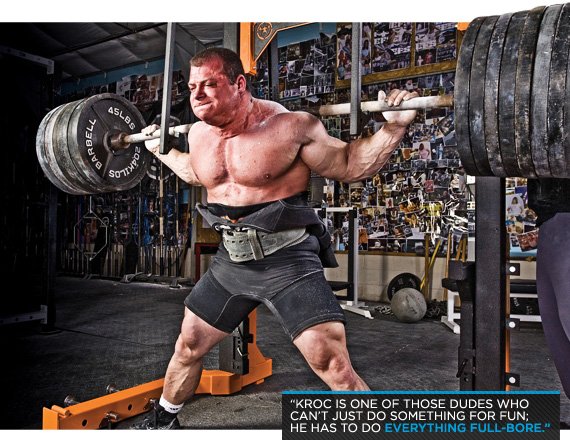
| Powerlifter vs. bodybuilder. |
Clearly, these guys that make it their priority to "show off how strong they are" are oftentimes just as muscular as the guys who don't give a rat's ass, and as I will explain below, EVERY bodybuilder you look up to is brutally strong and could throw you and your entire family over their heads. You have to understand that there is no way to separate strength from size. Additionally, while the manipulation of sets, reps and load is different between each style, there is one more factor each shares that needs to be discussed in isolation: progressive overload. To continue to elicit neurological strength or muscular hypertrophy adaptations, the stimulus (reps, sets, weight) must progressively increase.
Thus, a bodybuilder curling 65lbs for 8 reps and 6 sets must eventually curl:
- 70lbs for 8 reps and 6 sets
- 65lbs for 9 reps and 6 sets
- 65lbs for 8 reps and 7 sets etc.
So while you may not be concerned with how much weight you can lift for one repetition, you must still get stronger within the appropriate repetition and set range, as often as possible, to keep growing. If your maximum bench press for 1 repetition is 135lbs and you can hit 8 reps for 5 sets at 110lbs, by gradually increasing the number of reps to 12 and sets to 8, you will probably add another 5lbs onto your bench press maximum. You will have gotten stronger by virtue of adding sarcoplasmic volume and improving the muscles ability to utilize stored carbohydrate. This could happen over the course of a couple weeks if you're training on a body part split. You would then take things a step farther and subsequently move up to 115lbs for 8 reps, 5 sets. Now you're stressing the myofibril and in six weeks, you could increase your max bench to 145lbs, pump out 12 reps for 8 sets at 120lbs, and add a couple lbs of lean mass to your frame. This is the bodybuilder approach to weightlifting.
You may ask then, "What's wrong with that?" Well, consider this:
You may ask then, "What's wrong with that?" Well, consider this:
- Most of the bodybuilders/models you aspire to look like can bench 300-500lbs for 6-12 repetitions. You're about at a minimum 200lbs off from being able to come even CLOSE to the muscularity they possess. For example, watch the video on the left where Ronnie Coleman (eight-time Mr. Olympia) benches 495 for 6 reps.
- Many of them (including Arnold Schwarzenegger) were successful powerliters and Olympic lifters before they became bodybuilders. Through years of developing maximal strength, they had a great base of dense myofibril muscle tissue upon which they could now build sarcoplasmic hypertrophy.
- Most novice weightlifters following a basic strength template can add 20-40lbs onto their lifts each month for a period of 6-12 months or longer. It could initially take you up to TWO YEARS to achieve the same strength training with high reps, if you ever get there at all. You won't look too shabby, you may appear toned (as long as you aren't too fat) but you will be small and weak.
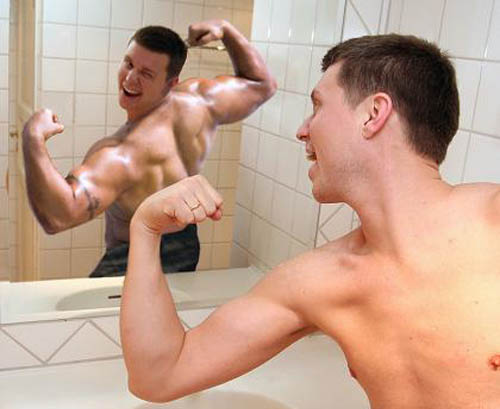 |
| Typical "bodybuilder". |
"Okay. So what do I do then?"
After all of that, the answer should seem pretty obvious. It's REALLY simple: Stop acting like a bodybuilder for now, because it's just an act, fool. We can all tell that you're new. That Greg Plitt physique is a couple years off but you'll probably have a decent shot at getting there if you can change your mindset (for now). First thing's first: No more chest/biceps/triceps/whatever day. That kind of routine will work much better when you're strong, for reasons I have already elaborated upon. That isn't to say that you should drop isolation movements and bodybuilding entirely, but the bread and butter of your early lifting should involve your entire body and be comprised of compound movements that utilize multiple joints like:- Bench press
- Squat
- Leg press
- Deadlift
- Overhead press
- Row
- Chin ups
- Pull ups
- Pull downs
 |
| SURPRISE MOTHERFUCKER. It's as simple as that. |

Good post. The only thing I found that I disagreed with is that I guess you think everyone is a douchebag. I know very little about weigh lifting, and I approach the subject on that assumption. Alienating your reader's, while funny, isn't the best way to get someone hooked on your posts.
ReplyDeleteAlso, try to dumb the technical details down some more. Going off the assumption that everyone reading this knows nothing about weightlifting, or muscle structure and biology in general, dont assume that a quick explanation in parenthesis are enough for the untrained, uninformed reader.
Good read, keep it up.
Thanks for reading Harrison. I never said that I think EVERYONE is a douche bag if they don't know anything about weight training, but it does aggravate me (and practically everyone else that lifts) when people curl in the squat rack. It's an important point to drive home, even if it pisses someone off.
DeleteI will definitely take your advice into consideration. Most of the technical terms are irrelevant (it's just how I write/speak.) but perhaps I'd do better to leave them out entirely and generalize.
BUUUUUUUU OL has 1000x less injury rates then gym traiing!
ReplyDeleteI didn't suggest that the injury rate is high, just that there is POTENTIAL for injury if you don't pay careful attention to technique. Like chin busting on the recovery during the clean, shoulder dislocation on the jerk or snatch. I'm targeting rank beginners or know-nothings that won't perform a snatch in the first place anyway. It's just a brief explanation.
ReplyDelete